In the vocational education sector, “VRQ” and “vocational delivery” are often used interchangeably — but they are not the same thing. For employers, learners, and training providers, understanding the distinction is essential for choosing the right qualification route and designing effective delivery models.
This blog breaks down the differences clearly, using current sector definitions and Ofqual‑regulated frameworks.
What is a VRQ? (Vocationally‑Related Qualification)
A VRQ is a structured, knowledge‑and‑skills qualification delivered primarily through classroom, blended, or centre‑based learning.
Key characteristics
- Study‑based learning: VRQs focus on theoretical knowledge and applied understanding.
- Structured training programme: Learners follow planned lessons, workshops, and guided practice.
- Assessment methods: Written assignments, exams, projects, case studies, and practical assessments in controlled environments.
- Regulated and recognised: VRQs sit on the RQF and are regulated by Ofqual, making them nationally recognised and accepted by employers and insurers.
- Ideal for pre‑employment learners: VRQs suit people who need structured learning before entering the workplace.
VRQs in Waste Management:
What is Vocational Delivery? (Competence‑Based / Work‑Based Learning)
Vocational delivery refers to competence‑based qualifications, most commonly NVQs, where learners demonstrate skills in real working environments.
Key characteristics
- Workplace‑centred learning: Competence is proven through real job performance.
- Assessment methods: Observation, portfolio evidence, witness testimonies, product evidence.
- Flexible, learner‑led progression: Learners complete units as they achieve competence, not through fixed timetables.
- Ideal for employed learners: NVQs suit individuals already working in the role or completing apprenticeships.
Vocational Delivery for Waste Management:
- CIWM (WAMITAB) Level 4 Operator Primary Competence – Transfer stations, Landfill, Treatment facilities
- CIWM (WAMITAB) Level 1-3 Waste & Recycling – Waste and Recycling Operatives
- CIWM (WAMITAB) Level 1-2 – Cleaning – Industrial and Domestic Cleaning
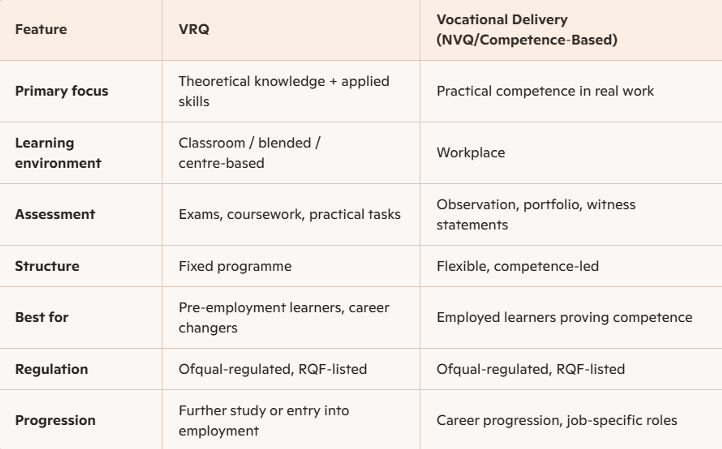
VRQ vs Vocational Delivery: Side‑by‑Side Comparison
Which Route Is Better?
The answer depends on learner status, sector, and employer expectations.
Choose VRQ when:
- Learners need structured teaching before entering the workplace.
- The sector requires strong theoretical knowledge (e.g., complementary therapies, fitness).
- You want predictable delivery schedules and centre‑based assessment.
Choose Vocational Delivery when:
- Learners are already employed and can demonstrate competence.
- The qualification is directly tied to workplace performance (e.g., cleaning, waste management, construction).
- Employers need evidence of real‑world capability.
This dual‑route model supports progression, improves employer engagement, and aligns with Ofqual’s regulated frameworks.
VRQs and vocational delivery are both essential parts of the vocational training landscape — but they serve different purposes. VRQs build knowledge and readiness; vocational delivery proves competence in real environments. For training providers, understanding and communicating these differences ensures learners choose the right pathway and employers receive the right skills.